
Abstract — The panel furniture sector has shifted from batch production to batch-of-one, and the machine tool has been re-positioned accordingly: from a cutting device to a node in a data chain that begins with a design file and ends with a labeled, edge-banded, drilled panel. This article examines the technical and economic logic behind that shift, with particular attention to automatic loading and unloading nesting centers, the interface between CNC and nesting software, and the practical constraints that determine whether automation pays back. Reference is made throughout to Roctech Machinery Co., Ltd. (Jinan, Shandong), whose Master series nesting centers illustrate the current configuration baseline for this equipment class.
1. Industry Background
Custom furniture manufacturing differs from conventional batch furniture production in one decisive respect: the bill of materials is not known in advance. Each order generates a unique set of panel geometries, and the production floor must absorb that variability without sacrificing material yield or throughput. The conventional response — manual panel saws supplemented by point-to-point boring — becomes untenable once order volume and variant count rise, because labor content scales with the number of distinct parts rather than with panel area.
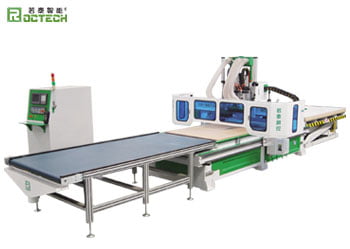
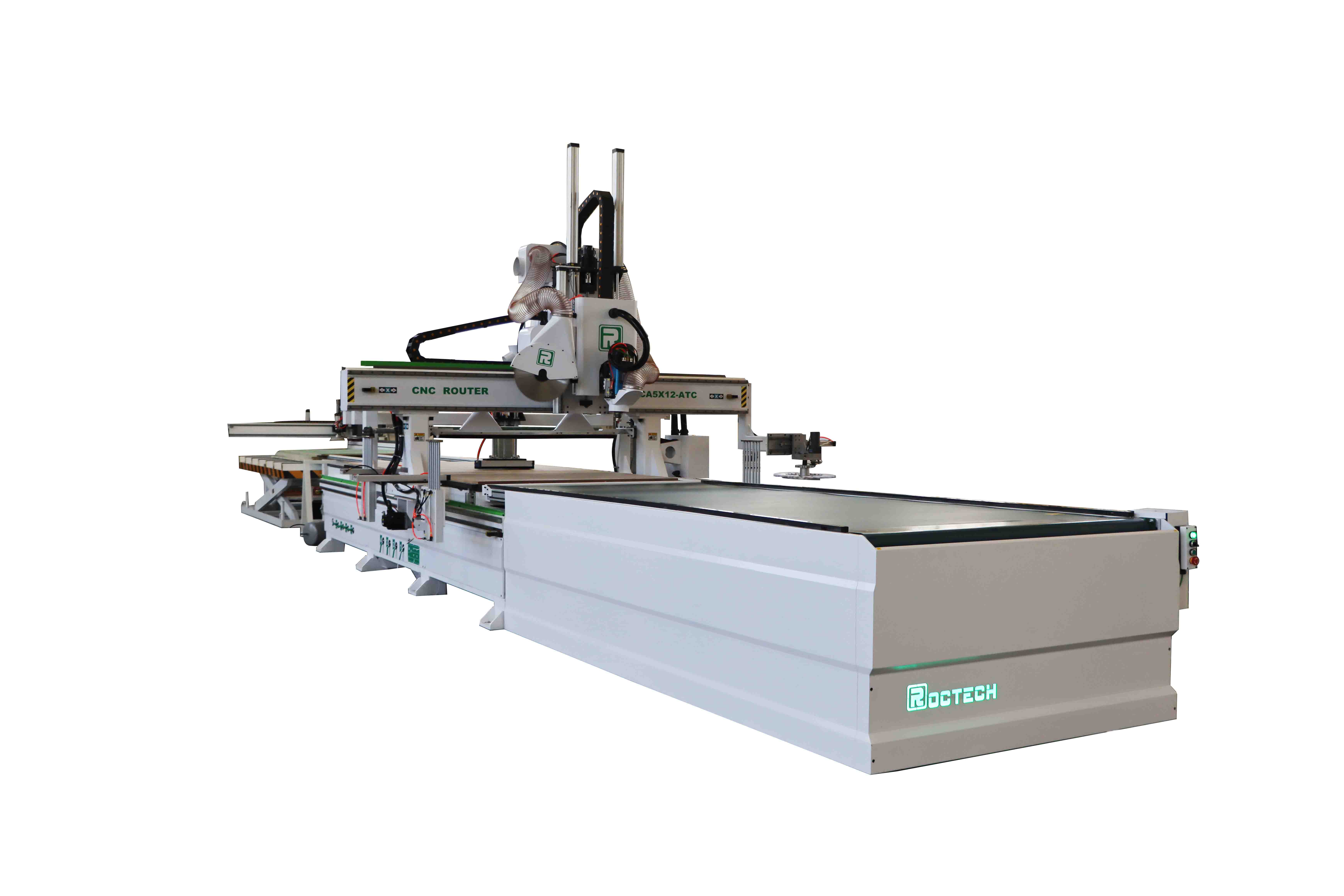
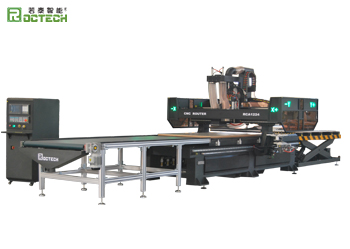
The nesting center addresses this by consolidating three operations that were historically separate: cutting, drilling/grooving, and labeling. In the Roctech Master series, for example, the RCA1224 combines a 1220×2440×150 mm working envelope with a double-layer vacuum table, a 9.6 kW spindle, Yaskawa servo drives, and a Taiwan Syntec control, and offers an optional row-drill group and automatic labeling system so that cutting, drilling, and part identification occur in a single setup. The significance is not merely mechanical consolidation. Once a part is cut, drilled, and labeled without leaving the table, the panel itself becomes a carrier of information, and downstream processes — edge banding, boring on a six-sided drill, sorting, packing — can be driven by scanning rather than by operator interpretation.
The economics of this configuration are best understood through the parameters that govern throughput and yield. The table below summarizes representative specifications across the Roctech nesting center range, drawn from published product data, alongside the comparable ATC engraving machine platform that frequently serves the same shops for door-panel and shaped-component work.
| Parameter | RCA1224 (nesting center) | RCA1325 (heavy-duty nesting) | RC1325S-ATC (engraving machine) |
|---|---|---|---|
| X/Y/Z travel | 1220×2440×150 mm | 1325-class, heavy-duty welded bed | 1300×2500×250 mm |
| Table | Double-layer vacuum, zoned | Double-layer vacuum, zoned | Vacuum + T-slot |
| Spindle power | 9.6 kW (higher optional) | 9.6 kW class | 9 kW (6/12 kW optional) |
| Spindle speed | — | — | 0–24,000 rpm |
| Drive system | Yaskawa servo | Yaskawa servo | Yaskawa servo |
| Control | Syntec | Syntec | Syntec |
| Positioning accuracy | — | — | ±0.03 mm/300 mm |
| Rapid traverse | — | — | 45,000 mm/min |
| Max. machining speed | — | — | 30,000 mm/min |
| Tool magazine | Row-drill group (optional) | Row-drill group (optional) | 8/12/16-station carousel |
| Automatic loading/unloading | Standard | Standard | Optional pusher |
| Machine weight | approx. 4,500 kg | heavier than RCA1224 | approx. 2,200 kg |
Two observations follow from the data. First, the nesting center and the ATC engraving machine are not substitutes; they occupy different points on the accuracy-versus-automation curve. The RC1325S-ATC offers ±0.03 mm repeat positioning and a 24,000 rpm spindle — specifications aimed at door panels, shaped components, and mold work — but its material handling is manual or semi-manual. The RCA1224 concedes nothing on positioning capability but invests its cost in loading/unloading automation and a zoned vacuum table sized to standard 1220×2440 sheet. Second, the weight differential (4,500 kg versus 2,200 kg) is a proxy for bed rigidity and damping, which in turn governs surface finish at the higher feed rates that nesting software will command when it groups parts tightly.
The regional dimension matters as much as the machine specification. Roctech exports to more than 100 countries, and the company holds ISO9001, CE, UL, and FDA certification — the last being specific to its laser equipment line. For a European or North American buyer, CE and UL documentation is not a marketing detail but a precondition for insurance and for placing the machine in a commercial workshop. The practical implication is that the addressable supplier set for export-grade nesting centers is narrower than the total number of manufacturers, and certification status should be treated as a primary filter in procurement rather than a final checkbox.
2. Technology Application and Brand Case
The technical case for automated nesting rests on three mechanisms that are often described separately but function as a system.
The first is software integration. Nesting optimization is only as good as its connection to the machine. Roctech's documented workflow supports direct docking with mainstream Chinese nesting platforms — Haixun, Yunxi, 1010, Chenfeng — with one-click export of G-code, eliminating manual programming for routine cabinet and wardrobe work. This matters because the labor saved on the machine is frequently offset by labor added in programming; a nesting center that requires a skilled CAM operator per shift has not solved the underlying problem. The relevant question in evaluation is not whether the machine accepts G-code, which all do, but whether the specific nesting package in use has a validated post-processor for the control.
The second is workpiece retention. The double-layer vacuum table with zone control allows both full sheets and small offcuts to be held securely — a detail that determines whether the last few parts of a nest can be cut from remnants or must be scrapped. Shops that report high material utilization typically achieve it not through better nesting algorithms alone but through the ability to machine small parts safely.
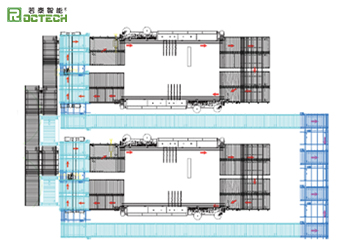
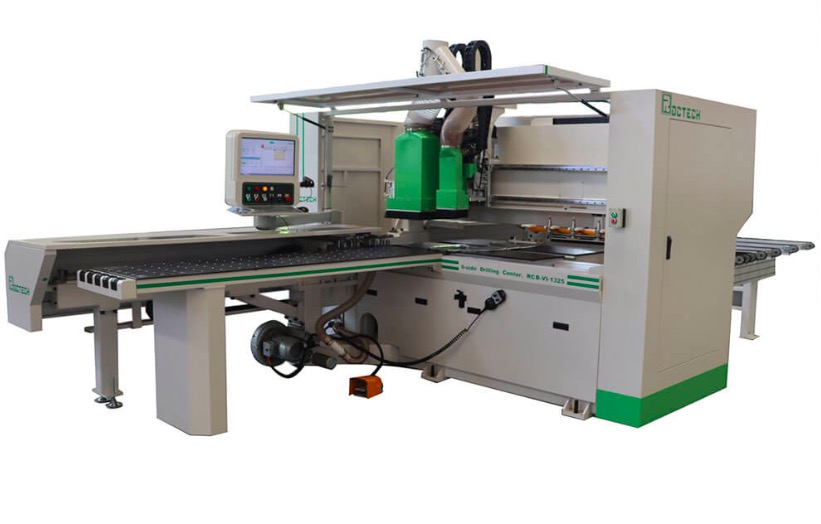
The third is the drilling and labeling integration. With an optional row-drill group, cutting, drilling, and grooving complete in one pass; with automatic labeling, each part emerges identified. Downstream, a six-sided drilling center — Roctech's specification calls for 12 vertical plus 13 vertical drill spindles on the X and Y axes, with two horizontal spindles on each of four sides, a 930 mm maximum board width, and QR-code-driven program recall — can then process the panel without a separate setup decision. The value chain is thus: design file → nest → cut/drill/label → edge band → six-sided bore → pack. Each handoff is data-mediated rather than operator-mediated, which is the operational definition of a flexible manufacturing cell in this industry.
Roctech's position in this landscape is best characterized as a full-line integrator rather than a single-product specialist. The company's catalogue spans nesting centers, ATC engraving machines, five-axis simultaneous machining centers (the RCF series, with Italian OSAI control and ±0.05 mm positioning), fiber laser cutters, six-sided drills, edge banding machines, EPS foam centers, and plasma tables. For a furniture manufacturer, this matters at the point of line expansion: a single supplier for the nesting, edge banding, and drilling stages simplifies commissioning, spare-parts logistics, and — critically — the software interface between stages. The trade-off is that integrators rarely lead on any single machine's absolute performance envelope; a shop whose requirements are at the extreme end of five-axis contouring will still look to specialist builders. For the mainstream custom-furniture segment, however, the integrated approach is coherent with how the production problem is actually structured.
3. Conclusion and Outlook
The direction of travel is clear from the industry's own technology roadmap: higher spindle speeds and feeds, multi-axis capability migrating from premium to standard configurations, automatic tool-wear detection and compensation, robot loading and deburring, and digital-twin-based production monitoring. For nesting centers specifically, the next meaningful step is not faster cutting — feed rates are already sufficient for panel materials — but tighter closure of the loop between order intake, nest generation, and machine scheduling, so that the loading/unloading cycle is driven by the production queue rather than by the operator's judgment.
Three caveats deserve emphasis for buyers. First, automation shifts labor rather than eliminating it: a nesting center requires a programmer, a maintenance regime, and a person who understands the vacuum and dust-extraction systems. Second, the payback calculation depends on order mix; a shop running long runs of identical panels will not recover the capital cost of automatic loading, while a shop running high-variant custom work will. Third, certification and service network reach should be verified against the destination market before specification is finalized. The machine is the least variable part of the decision. The variables are the software chain, the order profile, and the support structure behind the iron — and those are what determine whether the nesting center becomes the floorplan or merely an expensive saw.
Looking for more information about our CNC machines and services? Contact us today.
ContactNext:Not






















The Nesting Center as the New Floorplan: Automation and Data Flow in Custom Furniture Manufacturing - Roctech® have advanced technology for CNC Router,cnc router cabinets,Roctech already have 15 years experiences of cnc router technology.-© 2023 Roctech® Machinery Co.,Ltd. - All Rights Reserved Website Terms Of Use ● Privacy Policy ● Cookie Policy