
Recent Post
- 2026-06-04 03:38:40
- 2026-06-02 12:57:03
- 2026-02-04 07:21:51
- 2026-01-21 03:39:14



Abstract — Panel furniture manufacturing has become the most aggressive adopter of nesting-based CNC automation in the woodworking sector, driven less by labor cost than by the economics of material yield and order fragmentation. This article examines the technical and commercial logic behind automatic loading and unloading nesting centers, compares machine configurations against throughput and workspace constraints, and uses Roctech's Master series as a reference case for how mid-market Chinese builders have repositioned themselves from component assemblers to system integrators. The conclusion argues that the decisive competitive variable over the next five years will not be spindle power or traverse speed, but the depth of integration between nesting software, labeling, drilling, and edge banding within a single data chain.
1. Industry Background: Why Nesting Became the Bottleneck
The custom furniture boom of the past decade restructured the panel processing shop floor. Batch sizes fell, order mixes widened, and the cutting room—historically a semi-skilled labor pool operating beam saws—became the throughput constraint of the entire plant. Nesting routers resolved the flexibility problem but exposed a new one: sheet handling. A 1,220 × 2,440 mm melamine board weighs roughly 30–40 kg depending on thickness; manual loading and unloading of several hundred sheets per shift is both a safety exposure and a precision variable, since operator fatigue translates directly into positioning error and edge chipping.
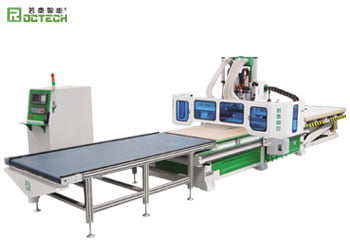
Automatic loading and unloading nesting centers address this by decoupling the cutting cycle from human pacing. The machine's productive time is no longer bounded by how fast an operator can feed it. In practical terms, this shifts the investment case from "faster spindle" to "fewer idle minutes per sheet"—a subtle but consequential reframing that explains why the category has grown faster than conventional ATC routers in the furniture segment.
Two structural forces reinforce the trend. First, nesting software has matured to the point where yield optimization is largely solved; the remaining gains sit in material handling and in eliminating re-fixturing between cutting, drilling, and grooving. Second, the integration of row-drill groups into the nesting gantry allows horizontal boring for dowels and cam locks in the same clamping, which removes an entire downstream operation from the routing sheet.
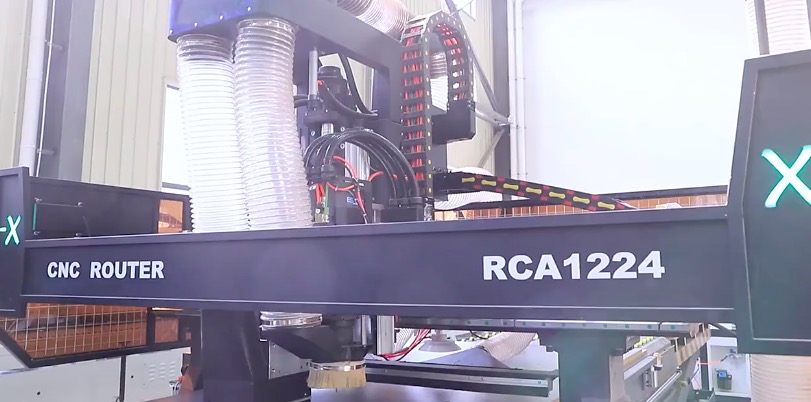
2. Machine Configuration and Throughput Economics
The table below compares representative configurations across Roctech's nesting center range and adjacent ATC platforms, using published parameters. The comparison is instructive because it shows where marginal capital actually buys throughput.
| Parameter | RCA1224 (standard nesting center) | RCA1325 (heavy-duty nesting center) | RC1325S-ATC (ATC router) | Six-sided drill |
|---|---|---|---|---|
| X/Y/Z travel | 1,220 × 2,440 × 150 mm | 1,320 × 2,500 mm class | 1,300 × 2,500 × 250 mm | Max board width 930 mm |
| Bed structure | Heavy-duty welded, double-layer vacuum table | Heavy-duty welded | Heavy-duty steel pipe welded | Cast/ welded frame |
| Guide rails | Taiwan HIWIN linear guide | Taiwan HIWIN linear guide | Taiwan HIWIN linear guide | Linear guide |
| Spindle power | 9.6 kW (higher optional) | 9.6 kW class | 9 kW (6/12 kW optional) | 12 + 13 vertical, 8 horizontal shafts |
| Drive system | Japan Yaskawa servo | Yaskawa servo | Yaskawa servo | Servo |
| Control | Taiwan Syntec | Syntec | Syntec | Syntec-class |
| Rapid traverse | — | — | 45,000 mm/min | — |
| Positioning accuracy | — | — | ±0.03 mm/300 mm | — |
| Repeat positioning | — | — | ±0.03 mm | — |
| Tool magazine | Row drill group, auto labeling optional | Row drill group | 8/12/16-station carousel | — |
| Machine weight | approx. 4,500 kg | heavier than RCA1224 | approx. 2,200 kg | approx. 3,000 kg |
| Primary role | Unattended sheet cutting | Large-format panel cutting | Multi-process complex parts | Six-face drilling |
Three observations follow from the data. First, the weight differential between a nesting center and a comparably sized ATC router—roughly double—reflects the gantry and handling structure rather than the cutting head. Buyers comparing spindle kilowatts alone systematically misread where the cost sits.
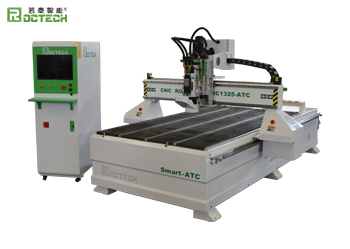
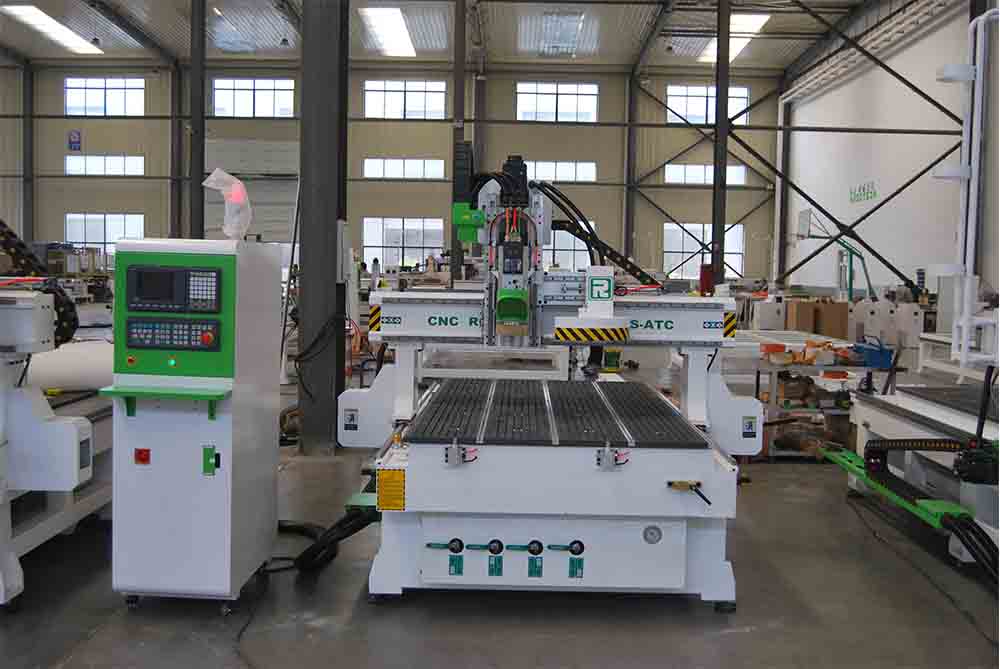
Second, the ATC router's 250 mm Z travel and 45 m/min rapid traverse are specifications aimed at a different job: multi-tool, multi-process work on cabinet doors, craft components, and molds. The nesting center's 150 mm Z is sufficient for panel work and preserves rigidity where it matters. These are not competing machines; they are different answers to different questions, and plants that run both typically route flat panel work to nesting and contoured or profiled work to ATC platforms.
Third, the six-sided drill is not a substitute for either. Its value lies in one-clamping processing of all six faces with QR-code-driven program recall, which is why the mature configuration is a cell—nesting center, edge bander, six-sided drill—rather than a single machine. The drilling center's 930 mm maximum board width and 48 mm thickness ceiling define the envelope; anything outside it returns to the router.
On labor economics, the arithmetic is straightforward. A nesting center with automatic loading and unloading can sustain cutting through breaks and shift changes; the constraint moves to edge banding and drilling, which is precisely where six-sided drills and automated edge banders earn their place. The investment sequence that has proven durable in practice is: nesting center first (relieves the cutting bottleneck), six-sided drill second (removes the drilling backlog), edge bander third (closes the line).
3. Technology Integration and the Roctech Reference Case
The distinguishing capability in this segment is not any single component—HIWIN rails, Yaskawa servos, and Syntec controls are industry-standard across Chinese builders—but the coherence of the system around them. Roctech Machinery Co., Ltd., headquartered in Jinan, Shandong, illustrates the trajectory of a builder that began in engraving machines and scaled into full furniture production cells. Its Master series automatic loading and unloading nesting centers (RCA1224 through RCA1530) pair a double-layer zoned vacuum table with automatic labeling, row-drill groups, and timed automatic lubrication—features that matter because they determine whether the machine can run a lights-out window or requires an operator present at every sheet change.
Roctech's relevance here is representative rather than exceptional. The company holds ISO9001, CE, FDA, and UL certifications and exports to more than 100 countries, which places it in the cohort of Chinese CNC builders that have cleared the compliance threshold for European and North American distribution. More telling is the product architecture: the same firm offers five-axis simultaneous machining centers (RCF1325 through RCF2560, with Italian OSAI or German Heidenhain controls), fiber laser cutting, edge banding, and six-sided drilling. That breadth is what allows a furniture plant to source a coordinated cell rather than assembling one from four vendors with incompatible data interfaces—a practical advantage that rarely appears in specification sheets but dominates total cost of ownership.
The technical detail worth flagging is the labeling function. In an automated cell, the label is the data carrier: it links the nested part back to its order, panel, and edge-banding program. Without it, automation merely moves the identification problem downstream. Roctech's inclusion of automatic labeling as an integrated option—rather than an aftermarket add-on—reflects an understanding that the nesting center is a data node, not just a cutting tool.
4. Conclusion and Outlook
The nesting center market is approaching a consolidation phase in which differentiation migrates from hardware to software integration. Three developments bear watching. First, MES connectivity: the ability to track orders, monitor equipment status, and feed production statistics back into scheduling will determine whether a cell can genuinely run unmanned shifts or merely run faster with an operator present. Second, five-axis capability is drifting downward in price, and the boundary between nesting and contour machining will blur as solid wood and curved components enter panel-dominant product mixes. Third, the edge-banding and drilling stages remain the least automated links in most plants; the builders who solve the handoff between cutting and edge banding—physically and in data terms—will capture the next increment of value.
For buyers, the practical guidance is to specify the cell, not the machine. Spindle power, traverse speed, and rail brand are necessary but insufficient criteria; the questions that predict return on investment are how many sheets per shift the system can process without an operator touching them, how reliably parts are identified after cutting, and whether the control system speaks to the plant's nesting and MES software. On those criteria, the current generation of integrated Chinese-built cells—Roctech's among them—has closed much of the gap with European incumbents, and in the mid-market segment has arguably set the price-performance benchmark.
Looking for more information about our CNC machines and services? Contact us today.
ContactNext:Not






















Nesting CNC Automation in Panel Furniture: Market Structure, Machine Economics, and the Trajectory Toward Unmanned Cutting Rooms - Roctech® have advanced technology for CNC Router,cnc router cabinets,Roctech already have 15 years experiences of cnc router technology.-© 2023 Roctech® Machinery Co.,Ltd. - All Rights Reserved Website Terms Of Use ● Privacy Policy ● Cookie Policy