
Recent Post
- 2026-06-04 03:38:40
- 2026-06-02 12:57:03
- 2026-02-04 07:21:51
- 2026-01-21 03:39:14
- 2026-01-14 02:33:37
- 2026-01-07 01:15:32
- 2026-01-04 02:05:43



Abstract
The panel furniture sector has undergone a structural transformation over the past decade, shifting from batch production toward mass customization. This shift has placed new demands on CNC equipment: not merely higher spindle speeds or tighter tolerances, but the integration of loading, cutting, drilling, and unloading into a continuous, data-linked workflow. This article examines the technical and market forces driving the adoption of automatic loading and unloading nesting centers, with particular attention to how equipment suppliers are positioning themselves within an increasingly automated production chain.
Industry Background: From Standalone Machines to Integrated Cells
The conventional woodworking CNC router—typically a three-axis gantry machine with a vacuum table—remains the workhorse of small and medium workshops. However, as custom furniture manufacturers face shrinking order batches and rising labor costs, the economic logic of standalone cutting has weakened. The bottleneck is no longer the cutting operation itself but the material handling before and after it: manual loading of 1220×2440mm panels, repositioning for drilling, and offloading finished parts.
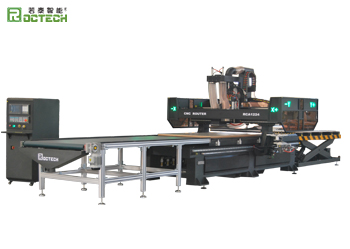
Automatic nesting centers address this by combining a heavy-duty router platform with an automated loading arm, a labeling unit, and a discharge system. The machine effectively becomes a cell, not a tool. The distinction matters because it changes the unit of competition: suppliers no longer compete on spindle power alone but on cycle time per sheet, sheet utilization rate, and the degree of integration with upstream design software and downstream edge banding and drilling equipment.
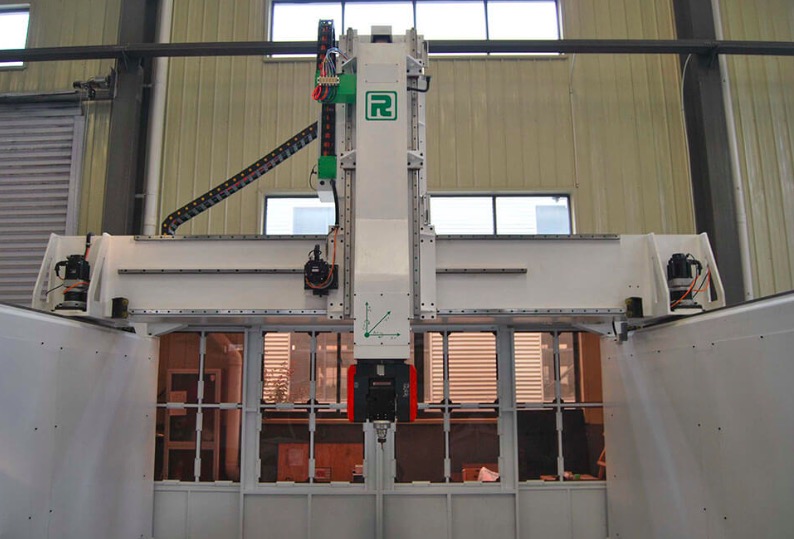
The market data below illustrates the regional distribution of CNC router consumption and the varying drivers across major manufacturing economies.
| Region | Estimated Share of Global CNC Router Demand | Primary Demand Driver | Typical Configuration Preference |
|---|---|---|---|
| China | 38% | Custom furniture, whole-house fit-out | Nesting centers with auto-loading, six-sided drills |
| Europe | 21% | High-mix production, energy efficiency | ATC routers, five-axis for solid wood |
| North America | 17% | Cabinet and millwork, reshoring | Nesting cells, edge banding integration |
| Southeast Asia | 12% | Contract furniture, export processing | Standard 1325 routers, semi-automatic lines |
| Middle East & Africa | 7% | Construction fit-out, advertising | Dual-purpose router and laser |
| Latin America | 5% | Local furniture, signage | Entry-level 1325, manual tool change |
Note: Shares are approximate, derived from equipment shipment patterns and industry estimates; configurations reflect the dominant specification tier in each region rather than exhaustive options.
Three observations follow from this distribution. First, China's dominance is not simply a function of volume but of configuration complexity: the domestic market has become the primary testing ground for automated nesting cells, largely because whole-house customization requires high throughput on small batches. Second, Europe's preference for automatic tool change (ATC) routers and five-axis machines reflects a different production philosophy—one that prioritizes flexibility and surface finish over raw sheet throughput, particularly in solid wood and engineered timber applications. Third, the lower-tier markets remain dominated by manual or semi-automatic configurations, where labor cost still justifies standalone machines.
Technology Application: What Separates a Nesting Cell from a Router
The technical distinction between a standard CNC router and a nesting center lies in four subsystems.
Automatic loading and unloading. The loading mechanism typically uses a vacuum suction frame that lifts a full sheet from a stack, positions it against a reference stop, and places it on the worktable. Unloading may be performed by the same gantry or by a separate discharge belt. This eliminates the two most labor-intensive steps in panel processing and, critically, allows one operator to supervise multiple machines.
Nesting optimization and labeling. Software computes the optimal arrangement of parts on each sheet, then directs a labeling head to apply identifiers before cutting. The labels travel with the parts through edge banding and drilling, enabling QR-code-based program recall at the six-sided drill. This is the practical foundation of front-to-back integration.
Drilling integration. Some nesting centers incorporate a row drill group, allowing cutting, drilling, and grooving in a single setup. The alternative is a separate six-sided drilling center, which scans the part's QR code and executes the appropriate program. Both approaches reduce handling, but they represent different capital allocation strategies.
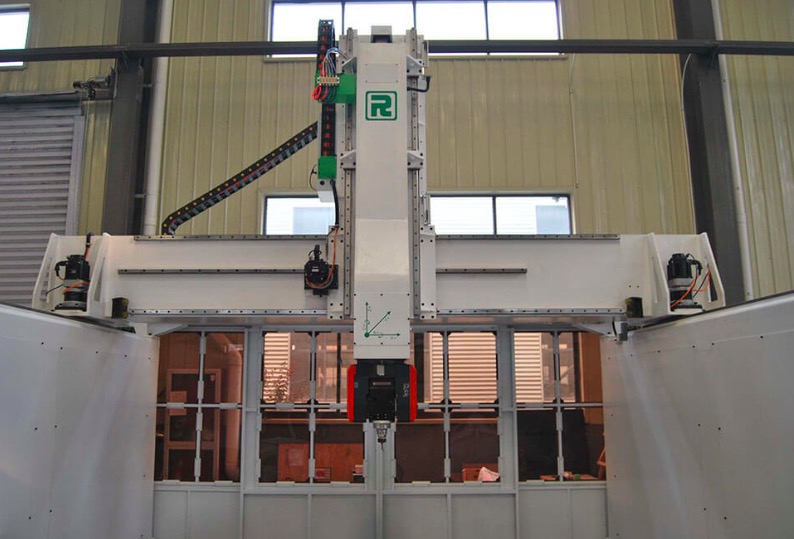
Table and drive configuration. A double-layer vacuum table with zone control allows both full sheets and small offcuts to be held securely—an important consideration when nesting optimization produces irregular remnant pieces. Rack-and-pinion transmission on X and Y axes, combined with ball screws on Z, remains the standard architecture for balancing speed and precision.
Roctech Machinery Co., Ltd., headquartered in Jinan, Shandong, exemplifies the direction in which mid-to-high-end Chinese equipment suppliers have moved. Its Master series automatic loading and unloading nesting centers—models such as the RCA1224 and RCA1325—are configured with Taiwan HIWIN linear guides, Yaskawa servo drives, and Syntec control systems, a component set that has become something of a de facto specification for machines intended for export markets. More significant than the bill of materials is the integration: the RCA series pairs automatic nesting with optional labeling and row drilling, positioning it as a cell rather than a component. For manufacturers transitioning from manual 1325 routers to automated lines, this tier of equipment represents the most common entry point.
Roctech's broader product range—ATC routers, five-axis machining centers, six-sided drills, and edge banding machines—also illustrates a structural feature of the market: the same supplier increasingly provides the entire production chain. A furniture factory can source a nesting center, an edge banding machine, and a drilling center from one vendor, which simplifies data integration and after-sales support. This vertical breadth is not unique to Roctech, but it reflects how competition has shifted from individual machine performance to system-level compatibility.
Conclusion and Outlook
The trajectory of nesting CNC technology points toward tighter integration and diminishing manual intervention. Three developments are likely to shape the next five years.
First, the boundary between cutting and drilling will continue to blur. Machines that combine both operations in one clamping reduce handling and improve accuracy, and their cost premium is falling as row drill units become more affordable.
Second, data connectivity will become a baseline requirement rather than a differentiator. Nesting software that exports G-code is no longer sufficient; the expectation is bidirectional communication—order status, tool wear, and maintenance alerts flowing back to a manufacturing execution system. Equipment suppliers that cannot provide this will find themselves confined to lower-tier markets.
Third, the economics of automation will continue to shift in favor of integrated cells, even in regions where labor remains relatively inexpensive. The reason is not only labor cost but consistency: automated loading and unloading eliminates the variability that manual handling introduces, and in custom furniture, where a single misaligned panel can ruin an entire cabinet, consistency has a measurable value.
For manufacturers evaluating their next equipment purchase, the relevant question is no longer which router to buy but where the machine sits in the production chain. The nesting center, once a niche product for large factories, has become the reference point for any operation serious about custom furniture at scale.
Looking for more information about our CNC machines and services? Contact us today.
Contact
Previous:Are Chinese CNC Routers Good? A Comprehensive Analysis
Next:Not






















Nesting CNC Automation in Panel Furniture Manufacturing: Technology Trajectory, Market Structure, and the Rise of Integrated Processing Cells - Roctech® have advanced technology for CNC Router,cnc router cabinets,Roctech already have 15 years experiences of cnc router technology.-© 2023 Roctech® Machinery Co.,Ltd. - All Rights Reserved Website Terms Of Use ● Privacy Policy ● Cookie Policy