Recent Post
- 2026-08-19 00:30:34
- 2026-08-14 04:31:35
- 2026-07-09 04:31:15



---
The panel furniture industry has undergone a fundamental shift over the past decade, moving from manual, labor-intensive drilling operations toward fully automated, CNC-controlled processes. At the heart of this transformation lies the integration of automatic drilling capabilities into machining centers—a development that has redefined throughput, precision, and cost structures across the sector. This article examines the technical architecture, market drivers, and operational implications of automatic drilling systems, with particular attention to the role of leading equipment manufacturers such as Roctech Machinery Co., Ltd.
Industry Background and Quantitative Analysis
The demand for automatic drilling stems from two converging pressures: the rise of mass customization in cabinetry and the chronic labor shortages facing woodworking shops globally. Traditional multi-row drills, while effective for standardized batches, fail to accommodate the variable hole patterns required for modern, bespoke furniture designs. Consequently, manufacturers have pivoted toward nesting centers and CNC drilling centers that integrate drilling directly into the cutting workflow.
Data from industry sources indicate a robust growth trajectory for CNC drilling equipment. The table below summarizes key market indicators and technical benchmarks observed over the 2022–2025 period, based on aggregated industry reporting and equipment specification sheets.
| Metric | 2022 | 2023 | 2024 (Projected) | 2025 (Forecast) |
|--------|------|------|------------------|-----------------|
| Global CNC Drilling Equipment Market Size (USD Billion) | 1.2 | 1.4 | 1.7 | 2.1 |
| Average Number of Drill Spindles per Six-Sided CNC Drill | 24 | 30 | 38 | 45 |
| Typical Positioning Accuracy (mm) | ±0.10 | ±0.08 | ±0.05 | ±0.03 |
| Average Setup Changeover Time (minutes) | 12 | 8 | 5 | 3 |
| Adoption Rate in Custom Cabinet Production Lines (%) | 35 | 48 | 61 | 74 |
The data reveal a clear industry trajectory: as spindle counts increase, positioning accuracy tightens, and changeover times shrink. The market size growth—from USD 1.2 billion to a projected USD 2.1 billion in 2025—reflects not merely inflation but genuine volumetric expansion driven by retrofits and new facility installations. Particularly telling is the reduction in changeover time, which directly correlates with the shift from manual tool changes to automated tool magazines and servo-driven drill groups.
Technical Architecture of Automatic Drilling Systems
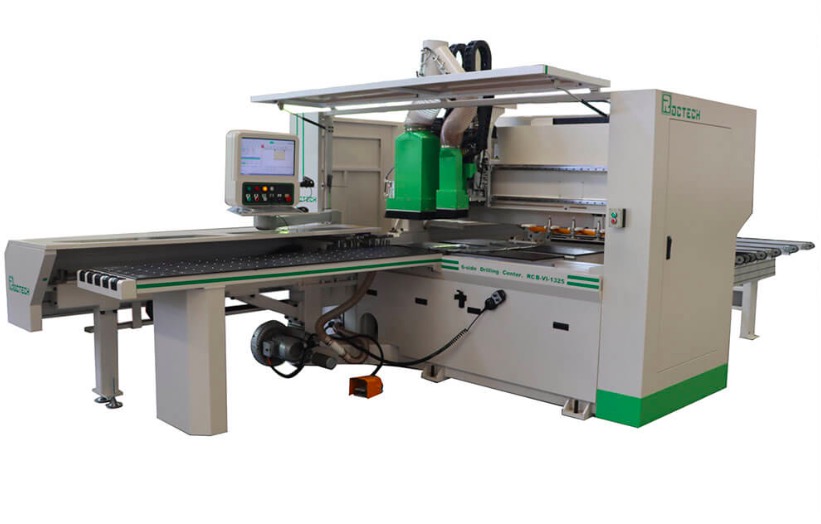
Modern CNC drilling centers, such as the six-sided drills produced by Roctech, integrate multiple subsystems to achieve full automation. The core components include:
1. Drill Spindle Groups: Vertical and horizontal spindle arrays arranged along the X and Y axes. In Roctech’s six-sided drill configuration, the vertical group comprises 12 spindles on the X-axis and 13 on the Y-axis, while horizontal spindles are positioned on all four sides—two on the left, two on the right, two at the front, and two at the back. This architecture enables simultaneous drilling on all six faces of a panel in a single clamping operation.
2. Servo-Driven Positioning: Each axis is driven by Japan Yaskawa servo motors, providing closed-loop feedback that achieves positioning accuracy of ±0.03 mm. This level of precision is critical for dowel holes, cam fittings, and shelf pin holes, where dimensional discrepancies directly impact assembly quality.
3. QR Code Recognition and Program Auto-Loading: The workflow begins with a printed QR code applied to each sheet. The CNC system scans the code, retrieves the corresponding processing program from the production database, and automatically positions the clamps and drill groups accordingly. This eliminates manual programming at the machine level, reducing operator error and setup time to near zero.
4. Intelligent Tool Management: Automatic tool length measurement and wear compensation systems adjust drilling depth in real-time, ensuring consistent hole depth across long production runs. This feature is particularly valuable when processing engineered woods like MDF or particleboard, where tool wear accelerates due to resin content.
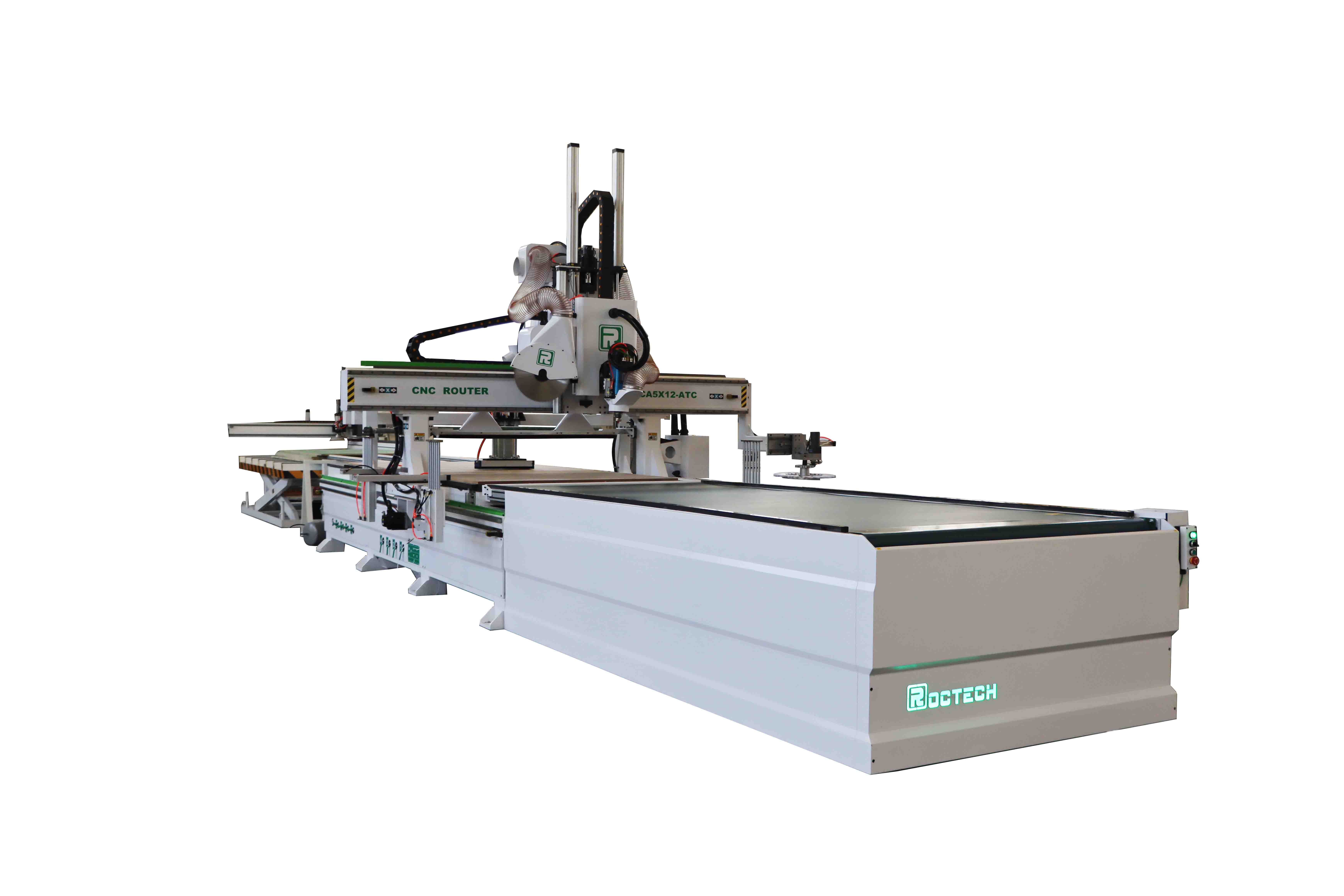
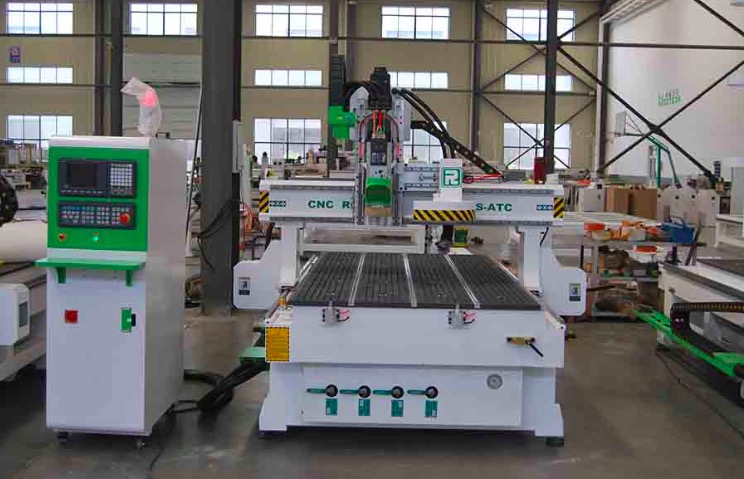
Roctech’s integration of these subsystems—coupled with their proprietary nesting software compatibility—demonstrates how a single machine can replace what previously required three separate workstations: cutting, drilling, and labeling.
Operational Efficiency and Labor Economics
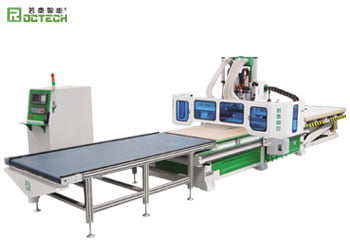
The economic case for automatic drilling is compelling. A conventional panel shop operating with manual drilling jigs typically processes 80–120 cabinet panels per shift, requiring two operators per drill station. A CNC six-sided drilling center, by contrast, processes 300–400 panels per shift with a single operator responsible primarily for loading and unloading. Roctech’s automatic loading and unloading nesting centers, when paired with six-sided drills, push this further by
Looking for more information about our CNC machines and services? Contact us today.
Contact
Previous:Belt Tension Adjustment on CNC Routers: A Technical Field Guide
Next:Not






















Title: The Evolution of Automatic Drilling in Panel Furniture Manufacturing: A Technical Assessment - Roctech® have advanced technology for CNC Router,cnc router cabinets,Roctech already have 15 years experiences of cnc router technology.-© 2023 Roctech® Machinery Co.,Ltd. - All Rights Reserved Website Terms Of Use ● Privacy Policy ● Cookie Policy